TEAM
Just me
 HJORTUR FREYR
Icelandic rota software either ignores collective agreements entirely or hardcodes one of them. Timr treats the agreement as data, because a single company can employ people working under four different ones.
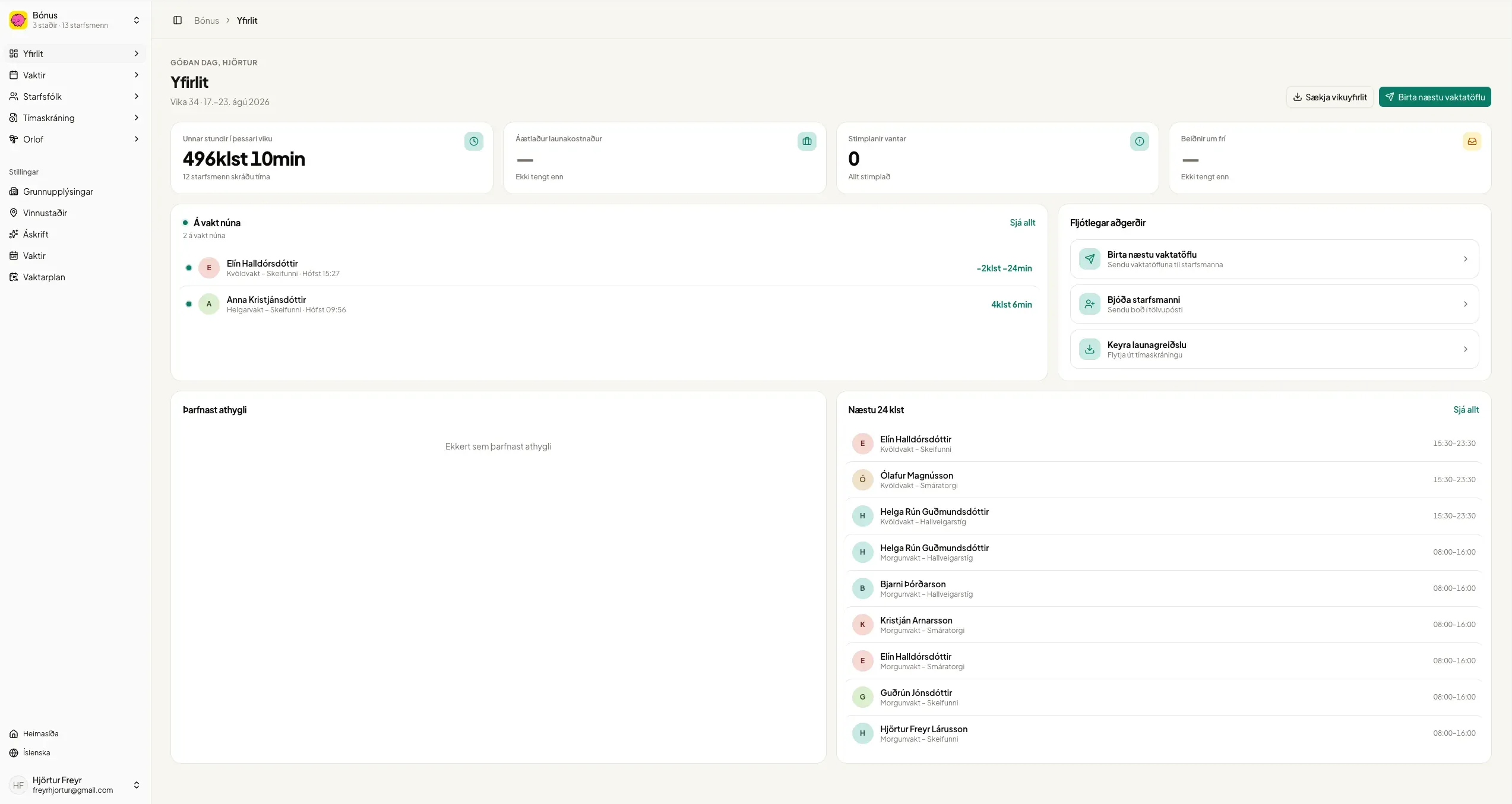
Every scheduling tool has to answer one question: was this hour ordinary time, overtime, or a premium? In Iceland the answer depends on which collective agreement covers the employee. Tourism sets the ordinary-hours window at 07:00–17:00. Hotel reception uses 08:00–17:00. Retail runs 09:00–18:00, office work 09:00–17:00. A car rental with a front desk, a workshop and an office employs people under all of them at once.
Hardcoding one window and calling it a setting would have shipped months earlier. It would also have been quietly wrong for most of the market, and wrong in the specific way that turns up in someone's payslip rather than in an error log.
The classification engine drove the architecture; billing and mobile both bent around it.
Day windows, monthly overtime thresholds, unpaid break lengths and premium bands all live in the database, resolved per employee rather than per company. Bands are keyed on weekday set plus clock range with validity dates, because a rate that differs between Friday and Monday evening cannot be expressed as three conditionals in a classifier. Each agreement row also stores the clause it came from and when that clause was last read.
Hours are classified against what the employee was published to work, which collapses two products into one. Salaried office staff are not a separate mode with separate rules — they are people rostered 08:00 to 16:00. One code path covers hourly, rostered and salaried, and there is no work-time-mode setting for anyone to get wrong.
The Expo app does clock in, clock out and see your shifts. Owners who sign in on mobile get a handoff screen that mails them a link to the desktop dashboard instead of a cut-down roster editor. Drag-and-drop scheduling on a phone is a bad product, and building it badly would have cost the month the app actually took to build.
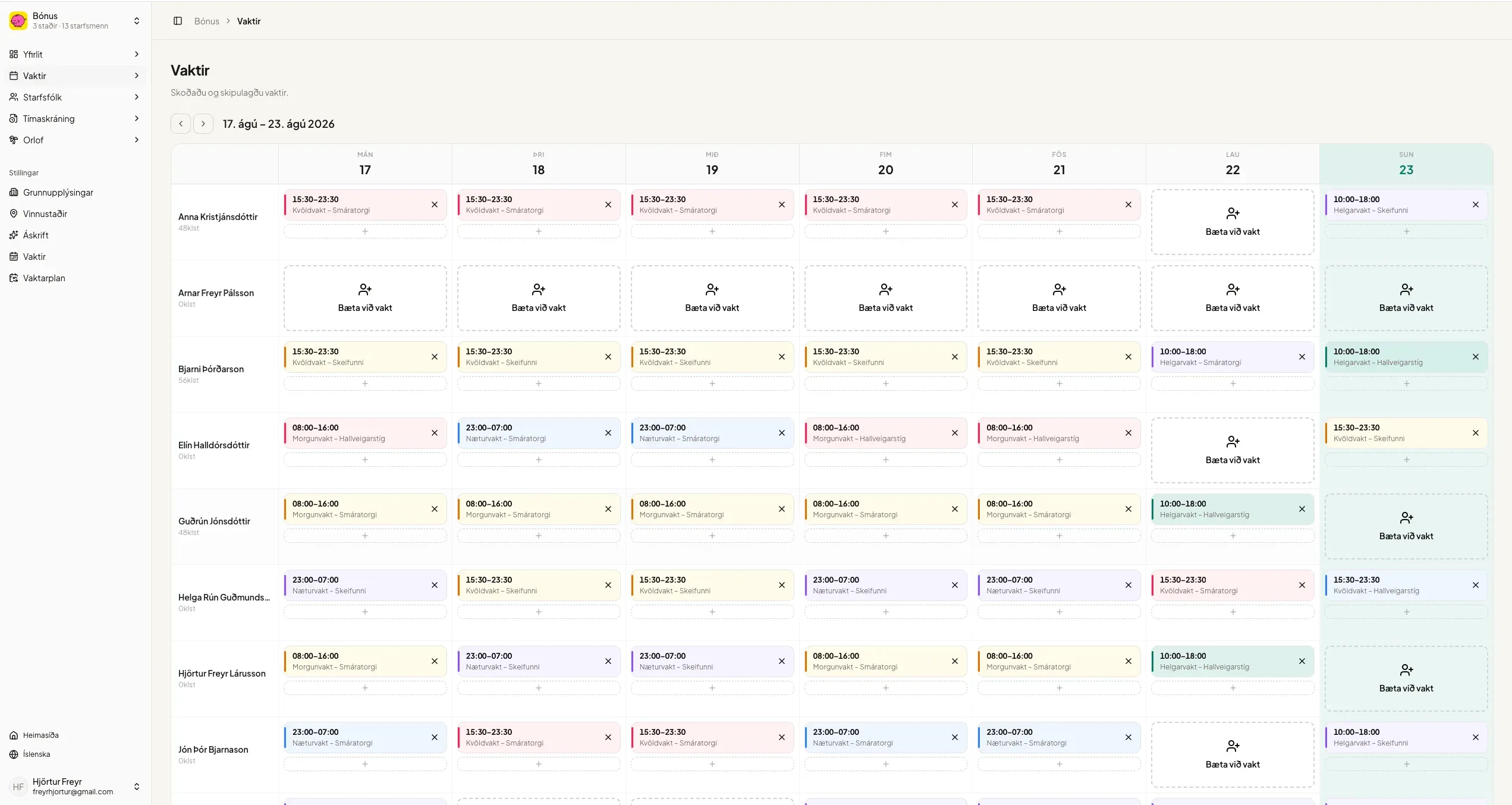
Managers build rosters privately and bulk-publish a date range; until then employees see nothing. Publishing snapshots the date and the employee onto the row, so reassigning or deleting a shift later cannot retroactively rewrite what someone was told they were working. Exports read soft-deleted shifts too, for the same reason — a shift deleted last month must not erase a day that was actually worked.
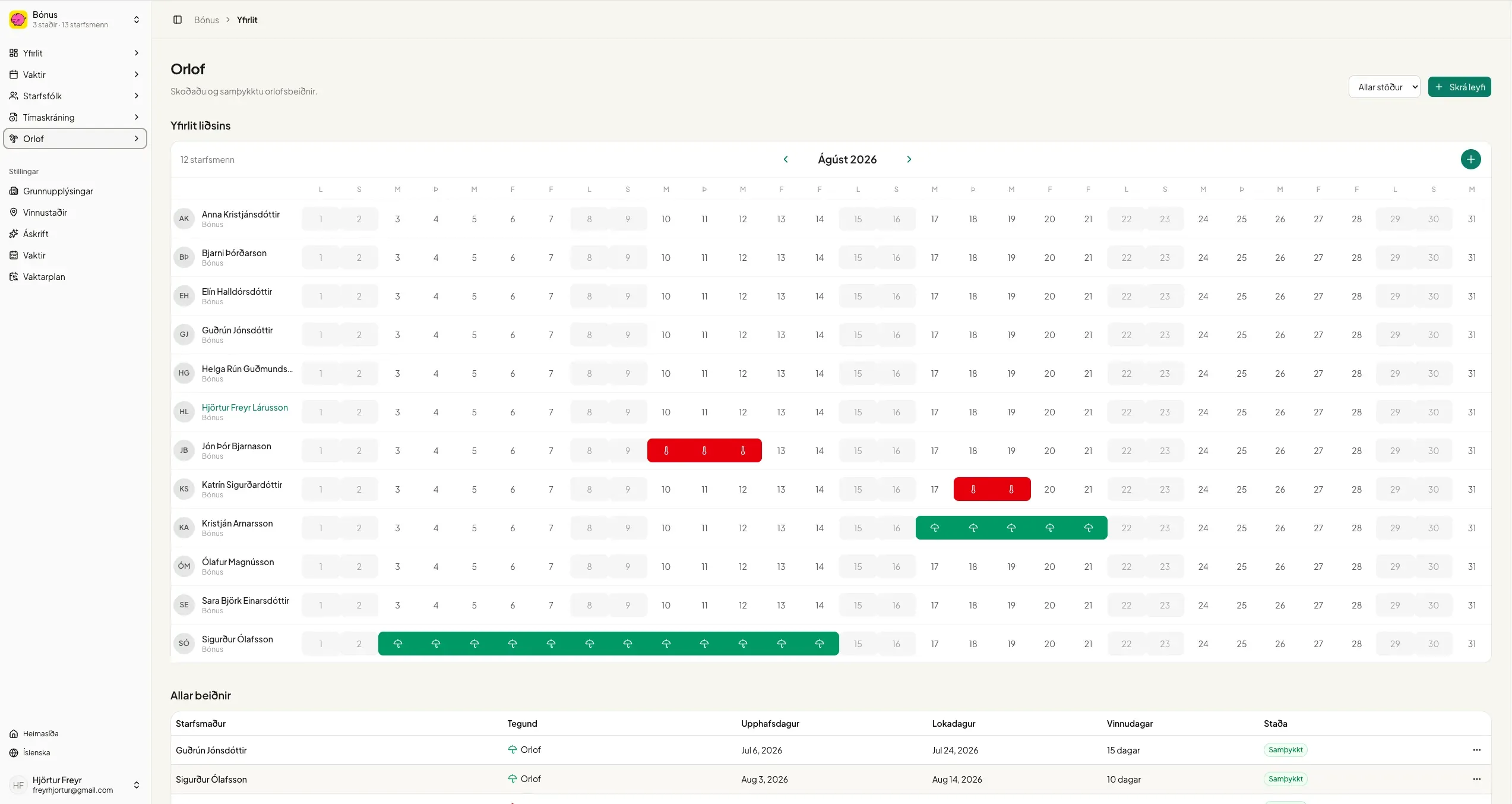
Icelandic vacation years do not follow the calendar, so balances are counted against a company-configured window, and a working day is whatever days the company is open minus the red days — editing opening hours rewrites the vacation math instead of leaving two settings to drift apart. Pending requests hold their days so the same balance cannot be spent twice, and only holiday deducts: sick, parental and unpaid leave are recorded without touching it. Everyone can see who is away, but the type is hidden unless the request is your own — the roster needs to know someone is out, not why.
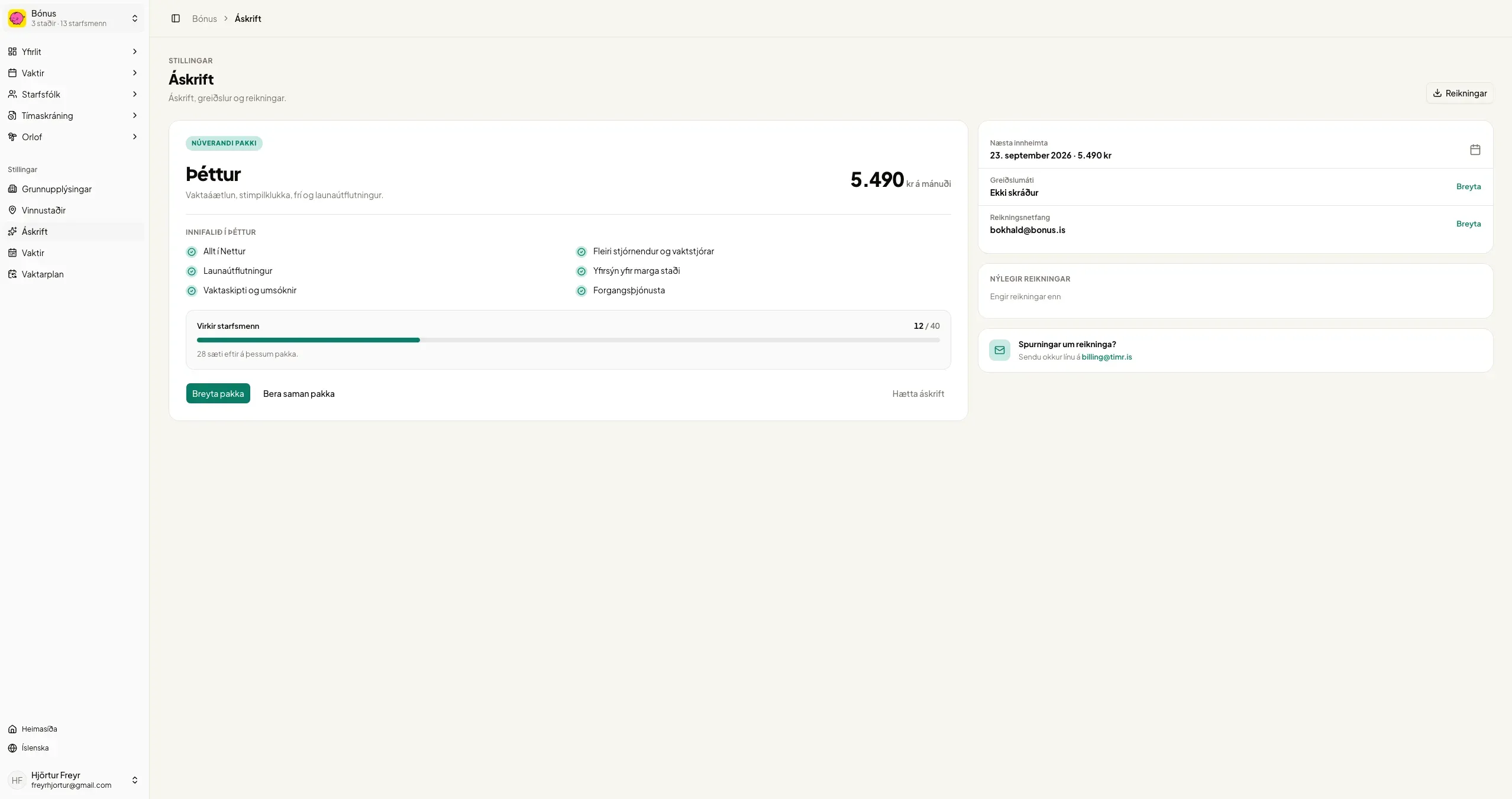
Three ISK tiers with employee caps, trial conversion, hosted checkout and merchant-initiated recurring charges through Verifone — no Cashier, no Stripe. Webhooks are verified as attached-payload JWS against the RFC 8785 canonicalisation of the request body, with keys selected by ID and a forced JWKS refresh for rotation. Billing routes deliberately sit outside the subscription middleware so a lapsed owner can still reach the page that lets them pay.
The classifier resolves a precedence chain — public holiday beats day off beats overtime beats premium beats ordinary time — and for most of that chain a single day is enough context. Overtime is not. Icelandic agreements set overtime thresholds monthly, so whether the 174th hour of a month is overtime depends on the 173 that came before it, not on the shape of that day's plan.
That breaks the natural implementation, where you classify a day and sum the results. A separate monthly path now counts the whole month even when only part of it was requested, then attributes the overtime back onto the days that crossed the line. The same constraint is why agreements are resolved for every employee up front, before any counting starts — a company can span several trades, so the lookup is per employee, and doing it inside the loop would put a query on every hour.
Premium bands started as conditionals in that classifier and did not survive contact with real agreements. SGS pays Friday evening differently from Monday evening; three ifs cannot express that. Moving bands into a table keyed on weekday set, clock range and validity date was the change that made agreement number four cost a row instead of a release. The whole thing sits behind 696 test cases, and the code carries its own warning that the interpretation needs checking against the source clause.